What Utah's 43% VLT Law Actually Means for Your Tint
You see vehicles with dark tint every day. Some are legal. Most aren't.
The difference comes down to understanding what **43% VLT** means and why the math matters more than the marketing on film packaging.
VLT Measures What Passes Through, Not What You Apply
Visible Light Transmission (VLT) is the percentage of visible light that passes through your window. Utah requires front side windows to allow at least 43% of light through.
Here's where people get it wrong.
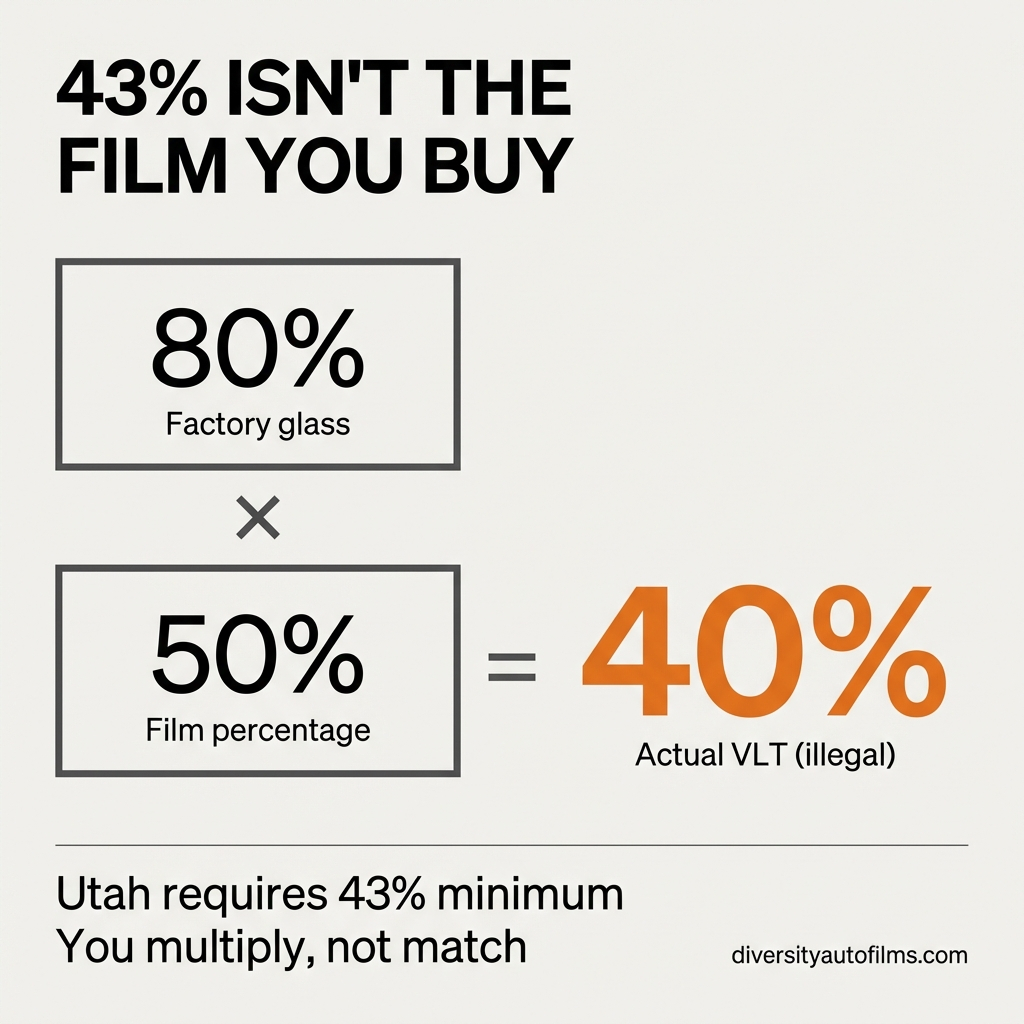
That 43% is measured as the **net value** after light passes through both your factory glass and any film you add. You're not measuring the film alone. You're measuring the combined system.
Your factory glass already blocks some light. Most vehicles leave the factory with glass that has 70% to 80% VLT. When you add aftermarket film, you multiply the two percentages together.
Apply 5% film to glass with 80% VLT and you get 4% combined VLT. Apply 50% film to that same glass and you get 40% combined VLT.
This is why you can't walk into a shop, ask for "43% film," and assume you're legal. The math doesn't work that way.
Why Officers Don't Need a Meter to Pull You Over
A window tint violation serves as valid probable cause in Utah.
If an officer suspects your tint exceeds legal limits from visual assessment alone, that's sufficient for a traffic stop. They don't need to measure first. They can pull you over based on appearance, then confirm with a tint meter.
Citations range from $70 to $100 for standard violations. Blatant disregard for tint restrictions qualifies as a Class C misdemeanor, which carries higher fines and potential jail time.
You get 14 days to correct the problem and show proof. That means removal, replacement with compliant film, or documentation that your tint was always legal.
The 2% Variance Allowance
Utah allows up to a 2% variance for aftermarket film. Your VLT can measure as low as 41% and still pass inspection.
This tolerance accounts for manufacturing variables and measurement conditions. Different meters, different temperatures, different angles—all of these affect readings slightly.
Professional installers factor this variance into their film selection. They don't push right up against the legal limit because measurement conditions during a traffic stop might differ from conditions during installation.
How Law Enforcement Measures Your Tint
Tint meters work by shining light through your window from one sensor to another. The receiving sensor measures how much light passes through and calculates VLT as a percentage.
These readings are precise. They serve as legal documentation.
Officers position the meter against your window, take the reading, and compare it to Utah's 43% requirement. If you're below that threshold, you get cited.
There's no negotiation about lighting conditions or visual perception. The meter provides the number that determines compliance.
Why Rear Windows Give You More Options
Utah allows any darkness on rear side windows and rear windows, but only if your vehicle has dual side mirrors.
This gives you maximum flexibility for privacy and heat rejection where visibility matters less for safe operation. You can go as dark as you want in the back while maintaining legal compliance up front.
Most people prioritize darker tint in rear areas anyway. Passengers appreciate the privacy. Cargo areas stay cooler. Interior materials in the back seat experience less UV exposure.
The legal structure in Utah recognizes this and removes restrictions where they don't serve safety purposes.
What Professional Installation Actually Provides
Professional installers measure your factory glass VLT before selecting film. They calculate the combined VLT to ensure you stay above 43% on front side windows while maximizing darkness within legal limits.
They test and verify compliance before you leave. You're not guessing. You're not hoping an officer's visual assessment goes your way. You have documented proof that your installation meets Utah requirements.
This removes liability from you and transfers it to the installer who's trained to apply tints within legal bounds.
When you handle it yourself or use an installer who doesn't measure and verify, you're accepting the risk of citations, removal costs, and reinstallation expenses to correct the problem.
The Compliance Advantage Beyond Avoiding Tickets
Legal tint protects your resale value. Buyers and inspectors reject illegal modifications. You either remove the tint before selling or accept lower offers from buyers who factor correction costs into their pricing.
Insurance complications arise if illegal tint is present during an accident claim. Adjusters document non-compliant modifications and use them to question other aspects of vehicle maintenance and legal operation.
You also avoid the time cost of dealing with fix-it tickets, scheduling removal appointments, and arranging reinstallation with compliant film.
Compliance isn't just about avoiding enforcement. It's about maintaining your vehicle's value and eliminating friction in situations where documentation matters.
How We Keep You Legal While Maximizing Darkness
We measure your factory glass VLT during consultation. We calculate the exact film percentage that gets you as close to the legal limit as possible without crossing it.
We account for the 2% variance allowance. We select films that maintain compliance even under varying measurement conditions.
We verify final VLT before you leave. You get documentation showing your installation meets Utah's 43% requirement for front side windows.
Your rear windows can go as dark as you want. We help you design a tint package that balances legal compliance up front with maximum privacy and heat rejection in the back.
You're not choosing between legal tint and effective tint. You're getting both because we understand the math and the regulations that determine compliance.
Call us or request a consultation through our website. We'll assess your specific vehicle, explain your options within Utah's legal framework, and provide a quote for installation that keeps you compliant while delivering the performance you're looking for.
