The $8,000 Question: What Paint Protection Film Actually Costs You NOT to Have
Last month, a Tesla Model 3 owner backed into his garage wall. His wife stopped when she heard the scrape, but the damage was done.
When he brought it to me, I expected a repaint job. The scrape looked bad—the kind of damage that sends you to a body shop for a week and costs you a few thousand dollars.
I heated up the PPF and peeled it off.
Underneath? Almost perfect paint. A few small dents that my PDR neighbor fixed in an hour. We reapplied fresh film. Three hours from drop-off to pickup.
Total cost: $400.
Without PPF? The body shop estimate would have run $1,000-$3,000 for a Tesla fender repaint, plus a week without the car.
That is the math nobody shows you when you are deciding whether PPF is worth the investment.
The "I'll Just Be Careful" Approach Fails 100% of the Time
You cannot drive carefully enough to avoid paint damage.
Rock chips happen on highways at 65mph when a semi kicks up gravel three cars ahead. Parking lot scratches happen when someone opens their door into yours. Road debris does not care how cautious you are.
I have watched this pattern for 14 years: customers who skip PPF thinking they will just avoid damage end up paying for that decision in small, compounding ways.
Here is what the "I'll be careful" approach actually costs:
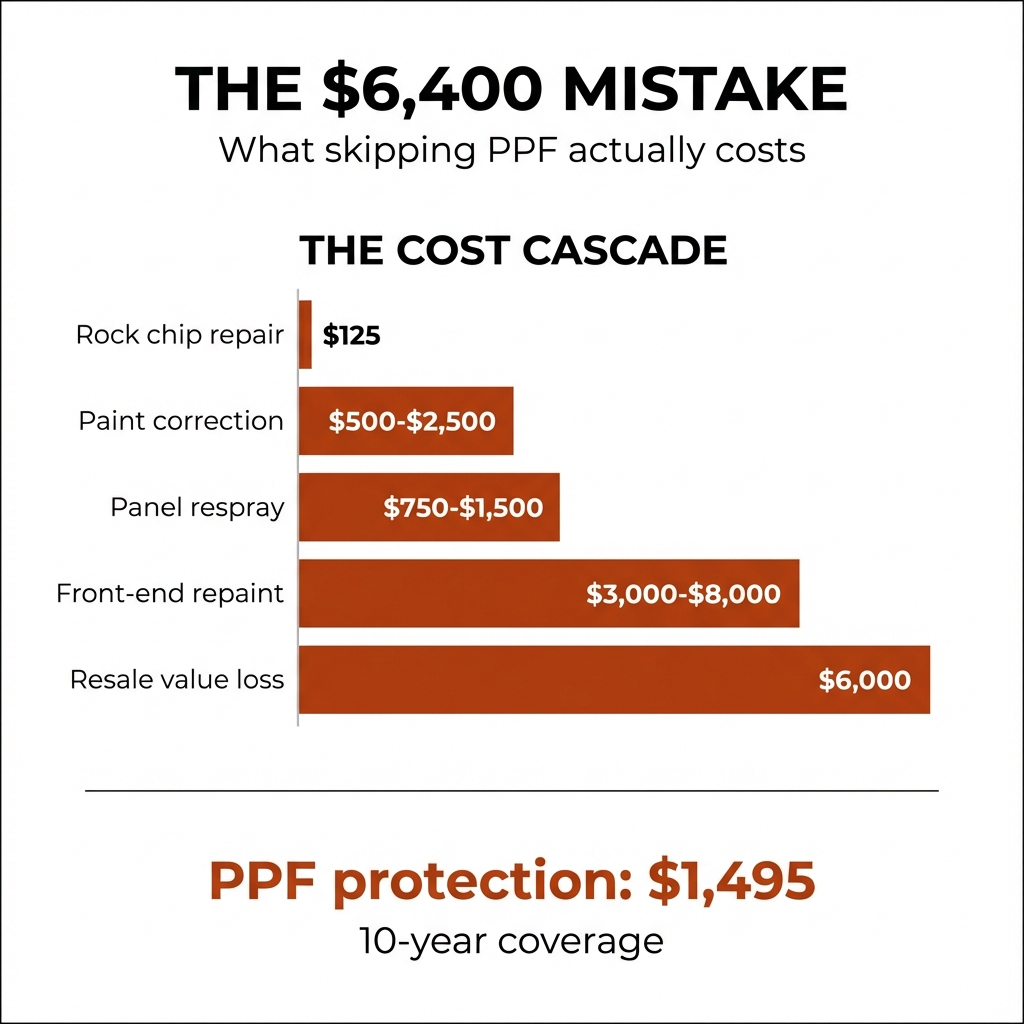
Single rock chip repair: $125 minimum
Professional shops charge $100-$400 per panel depending on how many chips you have accumulated. Touch-ups never look factory perfect—you can always see the thickness difference or the slight color mismatch.
Paint correction when scratches accumulate: $500-$2,500
Single-stage correction runs $500-$800. Multi-stage correction for years of accumulated damage? $1,000-$2,500. Severe correction on luxury vehicles can require 15-40 hours of labor.
Panel respray for concentrated damage: $750-$1,500 per panel
Body shops charge $650+ just for a front bumper respray. That includes color matching, blending, and several days in the shop. Multiple panels? The costs multiply fast.
Full front-end repaint: $3,000-$8,000
When the hood, bumper, fenders, and mirrors all need work, you are looking at the cost of repainting the entire front of your vehicle.
Compare that to $1,495 for full front PPF coverage that lasts 10-12 years with proper care.
The Compounding Cost Pattern Most People Miss
Paint damage does not stay contained.
That first rock chip lets water, dirt, and salt work their way under the paint. The chip spreads. Rust starts. What began as a $125 touch-up becomes a $650 panel respray within two years.
I ask customers on the fence about this: "Think about your last car. How long before the first rock chip showed up? How many did you have after three years?"
Most people get their first chip within six months. By year three, they have stopped counting.
The subset of customers who come to me after getting their first few chips? They are upset. They googled "how to prevent rock chips" and found PPF. Now they are paying for paint correction before installation because you cannot apply film over damaged paint.
Paint correction before PPF installation: $400-$1,500 additional cost
That is the price of waiting. You pay for the correction, then you pay for the protection you should have installed on day one.
The Resale Value Impact Nobody Talks About
Paint damage reduces your vehicle's resale value by 10-30%.
Minor blemishes and scratches? 10-20% value loss.
Faded paint? Up to 20% reduction.
Major scratches, dents, or rust spots? 30% or more.
Studies show that cars with clean, well-maintained paint sell for thousands of dollars more than similar vehicles with visible damage. Used car dealers report that vehicles with good paint condition are worth 10-20% more at trade-in.
When you fix paint damage before selling, you recover 8-10% of that lost value. But you are still paying for repairs that PPF would have prevented entirely.
On a $40,000 vehicle, a 15% value reduction means you lose $6,000 at resale. PPF costs $1,495 upfront and can reduce future repair costs by 40% over five years.
The math is not complicated.
Why People Skip PPF Even When They Know Better
Most of my customers use automated car washes even though they know they should not.
I tell them hand washing is the only way to keep PPF perfect for a decade. They nod. Then they use the automatic wash anyway because they are too busy to hand wash their cars every week.
The risk calculation makes sense to them: touchless car washes can cause PPF to peel by forcing high-pressure water under the edges. But regular automatic washes? The damage risk is probably less than 10%. Most customers are comfortable with that trade-off.
The psychology around the initial PPF investment works differently.
People who are willing to spend money on protection usually get it right away. It is self-explanatory—the longer you drive without it, the more damage accumulates.
But there is always a subset who wait. They get that first chip or two. It upsets them. They google solutions. That is when they find PPF and realize they should have installed it 10,000 miles ago.
The Premium Pricing Conversation
I had a customer email me last month saying my pricing was too expensive. He found a cheaper shop and went with them instead.
A month later, he emailed again. The cheaper shop did horrible work. He wanted me to redo it because I was who the dealership originally recommended.
I told him I would fix it, but I had to charge more than my original quote because I now had to remove the inferior installation first.
I do not negotiate on price. My relationships and reputation in the industry depend on consistent quality, not competitive bidding.
That is the reality of premium service: you pay for it once, or you pay for it twice.
What PPF Actually Protects Against
PPF prevents damage from low-impact objects:
• Rock chips and road debris
• Parking lot scrapes and door dings
• Shopping cart impacts
• Kids leaning on the car or removing bikes from the garage
• Minor scratches from brushes and environmental contact
I saw a C8 Corvette owner's PPF after 30,000 miles of normal driving. The film was extensively damaged—covered in chips, scratches, and impact marks.
He said he could only imagine how destroyed the paint would have been without protection.
That is what PPF does. It absorbs the damage that would otherwise require thousands in paint repairs over just a few years.
The One Truth I'm Certain Of
After 14 years of installations and repairs, I know this: paint damage is not a question of if, it is a question of when.
You can drive carefully. You can avoid highways. You can park far away from other cars.
It does not matter.
The rock chips will come. The scratches will accumulate. The paint will degrade.
The only variable is whether you protect against it upfront for $1,495, or pay for it in pieces over the next five years for $3,000-$8,000.
Most people who skip PPF do not realize they are making a financial decision. They think they are declining an optional luxury.
They are actually choosing the more expensive path.
You just pay for it later, when the damage is already done and the costs have compounded beyond what prevention would have required.
That is the cost-benefit analysis nobody shows you.
Now you have the numbers.
