How to Choose the Right Window Tint Darkness: A Step-by-Step Guide
I've walked hundreds of vehicle owners through this decision, and the confusion is always the same.
You want privacy. You want heat rejection. You want to stay legal. And you're staring at percentages that seem backwards (where lower numbers mean darker tint).
Here's how I help clients figure this out without regret.
Step 1: Understand What VLT Actually Means
Visible Light Transmission (VLT) measures how much light passes through your windows.
A 35% tint allows 35% of visible light through. A 5% tint allows 5% through (much darker).
What surprises most people: VLT percentages multiply, they don't add.
If your factory glass already has 80% VLT and you apply 50% film, your total isn't 130%. You get 40% (0.80 × 0.50 = 0.40).
This math matters when you're trying to stay legal.
Step 2: Know Utah's Legal Limits
In Utah, front side windows must allow more than 35% of light in. This law changed in May 2022 from the previous 43% requirement.
Back side windows and rear windows have no restrictions. You go as dark as you want.
Police use handheld laser meters to measure VLT with precision. You're not hiding illegal tint. Violations run $100 to $200 or more.
💡 Pro tip: If you tint any windows behind the driver, Utah requires dual side mirrors.
Step 3: Match Darkness to Your Actual Needs
I ask clients three questions:
1. Do you drive at night frequently?
A 35% tint keeps good visibility in low light while reducing headlight glare. Research shows elderly drivers struggle at 35% VLT, and all drivers have trouble at 20% VLT during nighttime.
If you're driving after dark regularly, stay at 35% or lighter on front windows.
2. What's your priority: privacy or visibility?
The visibility breakdown I share:
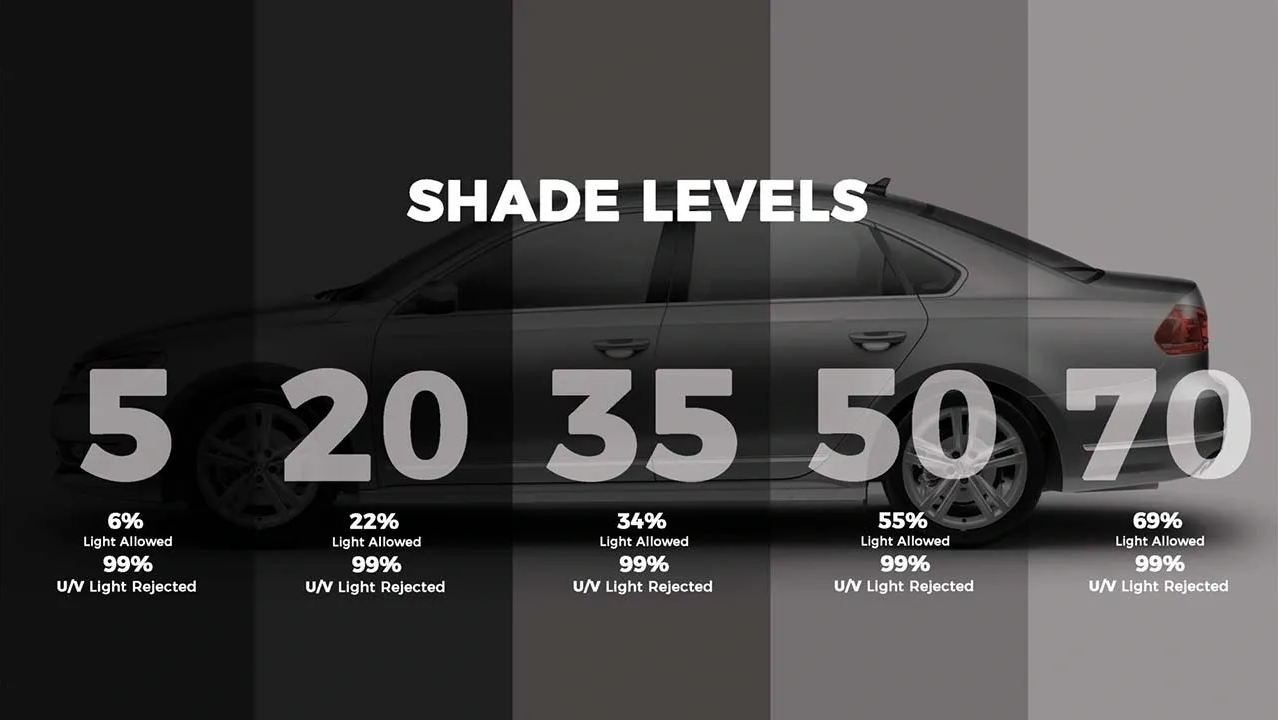
50% VLT: Minimal privacy, excellent visibility, blocks UV and heat
35% VLT: Good balance (decent privacy, safe night driving, legal on front windows)
20% VLT: Strong privacy, compromised night visibility, back windows only
5% VLT: Maximum privacy, severely limited visibility, back windows only
3. Are you focused on heat rejection?
This is where I correct the biggest myth.
Darker tint doesn't mean better heat rejection. Material quality matters more than darkness.
Infrared radiation accounts for 53% of solar heat, visible light contributes 44%, and UV is 3%. A film claiming "90% infrared rejection" isn't blocking 90% of total heat.
Look for Total Solar Energy Rejection (TSER) instead. Premium ceramic films reach 64% TSER at 35% VLT. You're blocking nearly two-thirds of the sun's total heat while staying legal and keeping good visibility.
Step 4: Don't Sacrifice UV Protection for Darkness
What most people don't realize: UV protection is independent of darkness.
Basic tints block 95-98% of UV radiation regardless of VLT. Premium ceramic films block 99%.
Even a 70% ceramic tint (barely noticeable) blocks 99% of harmful UV rays.
UV protection depends on film quality and materials, not how dark it looks.
My Recommendation Process
When clients ask me what to choose, I walk them through this:
For front side windows: 35% VLT using premium ceramic film. You stay legal, keep night visibility, get strong heat rejection, and block 99% of UV.
For back side and rear windows: Match the front at 35% for uniform appearance, or go darker (20% or 5%) if privacy's the priority and you don't need rear visibility for backing up.
⚠️ Important: If you choose different darkness levels front to back, the contrast looks mismatched from outside. I always recommend viewing sample installations before committing.
The Decision Framework
I tell clients to prioritize in this order:
1. Legal compliance (front windows above 35% VLT in Utah)
2. Safety requirements (night driving visibility)
3. Heat rejection performance (TSER rating, not darkness)
4. UV protection (material quality)
5. Privacy preference (aesthetic choice)
When you follow this sequence, you eliminate the regret I see from people who went too dark and couldn't see at night, or stayed too light and didn't get the privacy they wanted.
The math matters. The materials matter. The regulations matter.
Get all three right, and you'll have tint that performs exactly how you need it to.
